Combat back-to-school anxiety
16th Jul 2020Screen Time vs Green Time
29th Jun 2023
8 Tips to make Homeschooling easier for the whole family
2020 has been a year of big changes. From learning to tolerate a mask on our faces daily, to our children alternating days of when they’re at school, to teachers not hugging their little students to say hello. Life is not what it used to be and no one know when things will go back to ‘normal’, or if they ever will. Everyone has had to learn how to adapt, make changes, learn a new role and just survive. Most of us are no longer just able to drop our children off at school, go to work, pick them up and then spend the evening together. Mothers and fathers are now parents/teachers/homemakers/superheroes. It’s okay to feel uncertain and stressed with your newest “job responsibility”. We are all in the same boat – now we just need to stay afloat and get to our next destination.
My ‘new role’ was au pairing an awesome little 6-year-old girl some mornings and being a therapist for the rest of the time. WOW have I learnt a lot! Parents who are home schooling or doing online school with their children – I have to give you a lot of credit! It isn’t as easy as one would think. I found myself juggling keeping a young child entertained while watching YouTube videos, getting her to interact with her teacher on an IPad, complete a multitude of worksheets and still find time to do all the creative Pinterest ideas that were also on the school’s agenda. As an OT, I also couldn’t just do the bare minimum, I wanted to adapt some of the activities to make them more fun while working on necessary skills for Grade 1. ALL of this in just a few hours! This was enough to make anyone stressed on a good day. Having to juggle your work load and your child’s school work can cause anyone to feel overwhelmed. Some of you might feel that home schooling your child is a walk in the park. Others might feel that they do not have the expertise or the patience (mostly the patience 😊) for this new way of learning.
So with my rant now over, let’s try be constructive. It is not possible for us to change the amount of work the school sends home or the way they do it or have more time available to go through it all. What advice can I give, from my newfound experience, to help any parents having to go through a similar situation? How can we make ‘home-schooling’ easier on all of those involved?
Here are a few ideas:
- Routine, routine, routine… repeat! Children flourish on routine. A typical school setting is synonymous with routine. You child knows where they should be and when. Changes do happen but are often few and far between. With online school you school may have certain times that your child needs to be in ‘class’. For other schools that give you a set amount of work to go through a day; have a set time for your child to be ‘at school’. The pro about this is that you can schedule school time around your work schedule. Schedule time for different subjects for older children and time for fine motor/gross motor activities for younger children. Don’t forget your snack times and lunch breaks! (No one wants to learn when they’re hangry 😊). Having a planned out schedule helps your child feel less anxious and a bit more organized (it may help you too!)
A quick idea: Create a visual schedule with your child so at a glance they can see what is going to happen at what time. Let them cut out pictures from a magazine to represent each ‘class’ and make it into a fun fine motor activity.

- Move! – Movement breaks are not a new term to most but most of us sometimes dismiss them casually as something to do once in a while. Have you ever sat at a table working on your computer for a few hours and then later tried to stand up only to realise that it felt as though your body forgot how to do that? Or you’re sitting in a meeting and see that your foot is tapping as fast as though it’s starring in its own tap dancing competition? Young or old, our bodies were designed to move. For children who are used to moving between classes, having an active break and interacting with their friends. Sitting still at a desk for hours on end is a big ask for them. Now when I say move, it does not mean running a marathon in the garden. It can be as simple as getting up and doing 10 star jumps, or hopping around the table like a frog or even doing some roly-polys on the couch cushions. You can eve take a short break with them and practice a few yoga positions. Movement breaks like these will also help activate your child’s vestibular (movement) system which is closely linked to the listening and concentration centres of their brains. Therefore movement = better attention (so a win-win for all).
A quick idea: so that you don’t have to always be present, make a block out of paper or card board (like a dice) and on each side write a simple movement activity your child can do without you. When it’s time for a break, let them roll the dice and voila! No planning needed.

- Adapt! – Change things up! Chances are your child might not be in the mood for the schoolwork and you may not have the patience to convince them how long division is important for daily life. As OTs we love to make things fun! Try to make your child’s schoolwork more interesting and use yours (and their) imagination. This is not a typical situation and therefore we can’t expect “typical” responses or a “typical” school feel. So get those creative juices flowing to help make learning fun. The possibilities are endless.
A quick idea: If they have to practice reading, try do it outside. If they need to practice spelling words, write all the letter outside in chalk or on paper and let them jump on each letter to spell a word. If they need to practice counting, use playdough and let them make tiny balls to count as part of a ‘bird’s nest’. If they need to practice their letters, use sensory mediums (i.e. flour, shaving cream, mud, coloured rice) instead of just plain paper and pens.
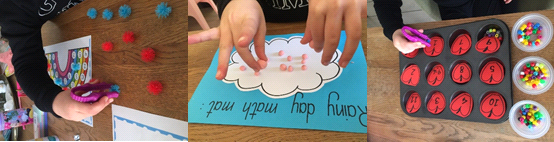
- Two birds with one stone – sometimes we want to help develop our child’s fine motor skills but all the creative ideas on Pinterest seem to require three hours of preparation and craft supplies that most of us don’t have. A simpler way is to work on these skills WHILE working through your child’s schoolwork. This is done by just changing the set-up of the task that the school has given or using different materials. For example, if your child needs count using an abacus, rather let them count beads by picking them up one-by-one using a peg. If they need to use counters, let them make them by rolling small balls of playdough between their index finger and thumb. If they are playing snap, place the cards for them to draw from on the opposite side to their dominant hand so that they have to cross the midline of their body to reach it. Simple things like this can change an activity from just stimulating your child’s mind to their body as well.
A quick idea: Some examples of ways I have slightly changed Grade 0 activities to also work on fine motor skills are shown in the pictures below. Having tweezers nearby will always be a success!
- Give them some independence – With everything changing at the drop of a hat, the future can feel uncertain for your child, more so when they don’t have any control in any decisions. Give them back a bit of control by involving them in the decision-making process. This can also motivate them more to participate, especially with difficult subjects.
A quick idea: For example, you can allow them to choose what order in which they do each subject or what movement break they want next. Letting a child choose the colour of the chair they want to sit on has been my number 1 way of winning them over when I first meet them.
- Motivation – Yes we do want your child to have intrinsic motivation to do tasks and do their best for themselves and not for an external person/reward, but it is also okay to use an extrinsic motivator, especially in atypical times (face it – nothing about 2020 is typical). One of the best ways to ‘reward’ your child is not necessarily with toys/sweets but rather with time. Often when I chat to my therapy kids after the holidays and ask what the best thing that they did was, the most common response is an adventure they went on or a place they visited with mom or dad.
A quick idea: Create a ‘Star Chart’ or even a ‘Button Bank’ for your child. With either one they will get a star or a button for completing tasks. At the end of the week/month, let them choose to ‘spend’ their star/buttons on different options such as a milkshake date with mom or dad, baking cookies together, playing a board game together, making a special art project together or having a family movie night where they choose the movie.
- Identify a study spot – Every area at school has a specific look, feel and purpose to it. Your child’s brain is trained to associate a certain activity to that area which helps them also feel more organized less anxious as they know what to expect when they are at a certain area. For example: the school gym is for PE, the playground is for playing, the carpet is for story time and your child’s desk is where they complete their structured tasks. It is therefore important to allocate a designated study spot so that your child knows when it is school time. Try not to allocate a study spot in an area typically associated with playing or watching television and limit external auditory and visual distractions as far as possible. Keep the items on the desk to a bare minimum and try choose a spot with a blank wall in front so that your child avoids the temptation to stare out the window for hours on end.
A quick idea: Take some masking tape and tape off a small square around the table in the study or the dining room where you child will always do their schoolwork. Give this area a cool name like the “Brain block” or “The Batcave” and let your child help with setting it up. This then becomes a special place where learning happens.

- Connect don’t correct – Your child is most likely experiencing a whole new world of emotions that they may not have experienced before. Children who were never anxious are now having a lot more anxiety and tears are a new household norm. For a parent, this can be overwhelming but also frustrating because you can cognitively reason with yourself about what is going on but your young child may not be able to do that. Instead of correcting their behaviour… try to first connectto what they are feeling. An example would be: if Joe is getting upset with the fact that he has to work and not play at home, you can reflect what you think they are feeling – i.e. “it seems like you are frustrated with all your school work.” Instead of saying: “why are you crying again… remember mom told you we don’t’ cry about school work, it needs to be done so stop it.” This can help your child your child identify with her feelings and learn to put a name to an emotion. This is an important step in helping them express and work through their feelings.
A quick idea: Make a monster box. Let your child decorate a box as a monster however they see fit, seal the box and cut a small hole in it where the mouth should be. When your child is feeling overwhelmed, let them (or you can help) write what they are feeling on a piece of paper. Let them fold up the paper and place it in the monster’s mouth so that they can ‘eat them up’. This is a fun way to help your child let go of any negative emotions.
If there is anything that you may take away from this, it is to never forget to just have fun with your child. Try to find time to connect with them and balance work and play. If the only thing your child remembers from this year is the extra time that they spent with you, then this whole year is worth it.
Take a breath. Give yourself some grace. Parents, you are doing a great job.

Check out our Care to Talk Discussion on Facebook for more information on this topic or please feel free to contact us for an appointment to discuss this in more detail.